Microsoft chip breakthrough could accelerate quantum computing within years
Microsoft claims that quantum computers could be built within years rather than decades, thanks to a new breakthrough. The company has developed a chip that could accelerate the development of quantum computing, similar to how semiconductors revolutionized modern electronics.
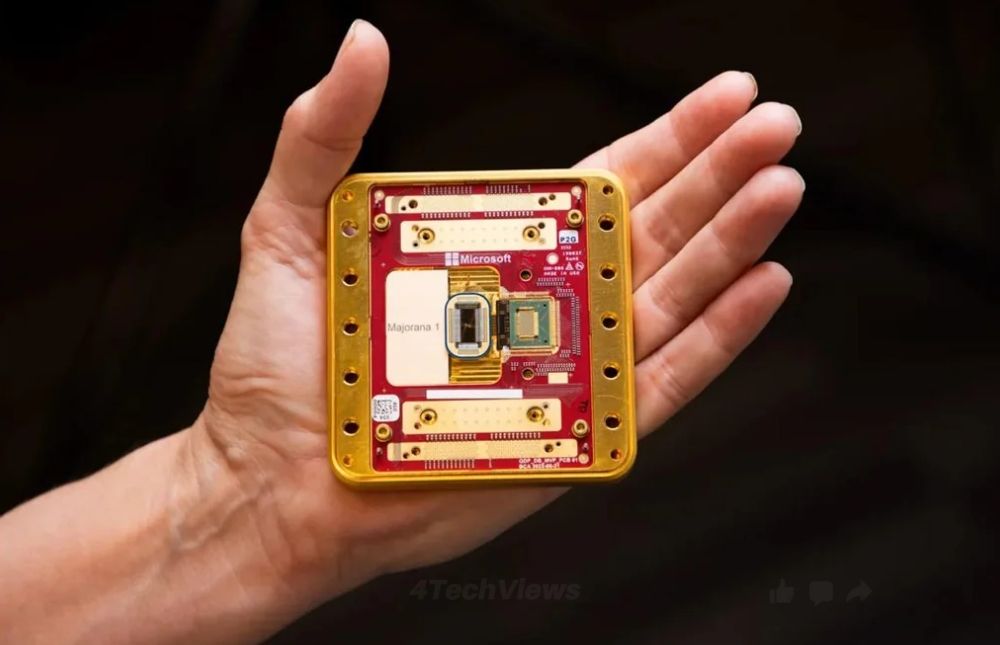 This chip is powered by the world’s first topoconductor, a material that creates a new state of matter beyond solids, liquids, or gases. A peer-reviewed paper in Nature states that this innovation allows for quantum systems to fit onto a single chip smaller than a hand, improving reliability.
Paul Stevenson, a physics professor at the University of Surrey, believes Microsoft could become a major competitor in the quantum computing race if it continues to advance this research. However, he remains cautious, stating that while the development is promising, the next steps are challenging.
George Booth, a theoretical physics professor at King’s College London, called the achievement impressive but noted that its true impact would only be clear in hindsight. He questioned whether quantum computing could truly be achieved within years rather than decades.
Microsoft asserts that the topoconductor provides a pathway to quantum systems scalable to a million qubits. Qubits, the fundamental units of quantum computing, differ from classical bits and can enable breakthroughs in industrial and societal challenges. These could include breaking down microplastics, developing self-healing materials, optimizing supply chains, and cracking encryption codes.
Earlier this month, the US Defense Advanced Research Projects Agency (DARPA) selected Microsoft’s topoconductor as one of two potential approaches to quantum computing. The agency aims to determine whether an industrially viable quantum computer can be built by 2033. The other contender, PsiQuantum, is working on a quantum system using silicon-based photonics, relying on light waves.
Microsoft previously claimed to have developed topological qubits, but a research paper was later retracted due to scientific flaws. Despite slower progress compared to some competitors, Microsoft has focused on building a system more resilient to interference.
Booth explained that Microsoft's approach relies on Majorana fermions, a type of particle that can protect information from being lost during processing. However, creating these qubits is more complex than other existing architectures. Since Majorana particles do not naturally occur, Microsoft had to generate them using magnetic fields and superconductors—one reason why most quantum research has taken different paths.
Although Microsoft’s platform could rival more established quantum technologies, significant challenges remain in scaling up the system for real-world applications.
This chip is powered by the world’s first topoconductor, a material that creates a new state of matter beyond solids, liquids, or gases. A peer-reviewed paper in Nature states that this innovation allows for quantum systems to fit onto a single chip smaller than a hand, improving reliability.
Paul Stevenson, a physics professor at the University of Surrey, believes Microsoft could become a major competitor in the quantum computing race if it continues to advance this research. However, he remains cautious, stating that while the development is promising, the next steps are challenging.
George Booth, a theoretical physics professor at King’s College London, called the achievement impressive but noted that its true impact would only be clear in hindsight. He questioned whether quantum computing could truly be achieved within years rather than decades.
Microsoft asserts that the topoconductor provides a pathway to quantum systems scalable to a million qubits. Qubits, the fundamental units of quantum computing, differ from classical bits and can enable breakthroughs in industrial and societal challenges. These could include breaking down microplastics, developing self-healing materials, optimizing supply chains, and cracking encryption codes.
Earlier this month, the US Defense Advanced Research Projects Agency (DARPA) selected Microsoft’s topoconductor as one of two potential approaches to quantum computing. The agency aims to determine whether an industrially viable quantum computer can be built by 2033. The other contender, PsiQuantum, is working on a quantum system using silicon-based photonics, relying on light waves.
Microsoft previously claimed to have developed topological qubits, but a research paper was later retracted due to scientific flaws. Despite slower progress compared to some competitors, Microsoft has focused on building a system more resilient to interference.
Booth explained that Microsoft's approach relies on Majorana fermions, a type of particle that can protect information from being lost during processing. However, creating these qubits is more complex than other existing architectures. Since Majorana particles do not naturally occur, Microsoft had to generate them using magnetic fields and superconductors—one reason why most quantum research has taken different paths.
Although Microsoft’s platform could rival more established quantum technologies, significant challenges remain in scaling up the system for real-world applications.
This chip is powered by the world’s first topoconductor, a material that creates a new state of matter beyond solids, liquids, or gases. A peer-reviewed paper in Nature states that this innovation allows for quantum systems to fit onto a single chip smaller than a hand, improving reliability.
Paul Stevenson, a physics professor at the University of Surrey, believes Microsoft could become a major competitor in the quantum computing race if it continues to advance this research. However, he remains cautious, stating that while the development is promising, the next steps are challenging.
George Booth, a theoretical physics professor at King’s College London, called the achievement impressive but noted that its true impact would only be clear in hindsight. He questioned whether quantum computing could truly be achieved within years rather than decades.
Microsoft asserts that the topoconductor provides a pathway to quantum systems scalable to a million qubits. Qubits, the fundamental units of quantum computing, differ from classical bits and can enable breakthroughs in industrial and societal challenges. These could include breaking down microplastics, developing self-healing materials, optimizing supply chains, and cracking encryption codes.
Earlier this month, the US Defense Advanced Research Projects Agency (DARPA) selected Microsoft’s topoconductor as one of two potential approaches to quantum computing. The agency aims to determine whether an industrially viable quantum computer can be built by 2033. The other contender, PsiQuantum, is working on a quantum system using silicon-based photonics, relying on light waves.
Microsoft previously claimed to have developed topological qubits, but a research paper was later retracted due to scientific flaws. Despite slower progress compared to some competitors, Microsoft has focused on building a system more resilient to interference.
Booth explained that Microsoft's approach relies on Majorana fermions, a type of particle that can protect information from being lost during processing. However, creating these qubits is more complex than other existing architectures. Since Majorana particles do not naturally occur, Microsoft had to generate them using magnetic fields and superconductors—one reason why most quantum research has taken different paths.
Although Microsoft’s platform could rival more established quantum technologies, significant challenges remain in scaling up the system for real-world applications.


Comments
Post a Comment